Aquarius, the Water Carrier, is the eleventh sign of the zodiac. In Western astrology it covers people born from about January 20 to about February 18. The start and end dates can move by a day in some years because the calendar doesn’t line up exactly with the Sun’s yearly path. Many older references, including earlier versions of this page, gave the range as January 21 to February 19. Aquarius is a fixed air sign. Its modern ruling planet is Uranus and its traditional ruler is Saturn. Astrologers link it with independence, ideas, friendship and causes bigger than the self. Astrology is a tradition people use for reflection and fun, not a science, so treat what follows as character sketches, not facts about you.
Aquarius at a glance
| Feature | Aquarius |
|---|---|
| Usual dates | About January 20 to February 18 (can shift by a day) |
| Symbol | The Water Carrier (water bearer) |
| Element | Air |
| Modality | Fixed |
| Modern ruling planet | Uranus |
| Traditional ruling planet | Saturn |
| Color linked to the sign | Turquoise |
| Starstone | Turquoise |
| Body area in traditional astrology | Calves, ankles and circulation |
The Aquarius personality
Traditional astrology describes Aquarians as people with strong, attractive personalities who come in two main types. One type is shy, sensitive, gentle and patient. The other is lively, outgoing and showy, and sometimes hides real depth behind a playful surface.
Both types are described as strong-willed, with firm convictions. Because they value truth above almost anything else, they will usually change an opinion, however firmly held, if new evidence shows them they were wrong. They are said to see the big picture and pull many different factors into one whole. They can see both sides of an argument and still decide which side to take.
That makes the sign, in astrological terms, unprejudiced and tolerant. An Aquarian can see why an argument holds up even when they don’t accept it. The attitude matches a well-known query in the Quaker Advices and Queries: “Are you open to new light, from whatever source it may come?”
Both types are described as humane, frank, serious-minded, friendly, refined, sometimes otherworldly and idealistic, with the idealism balanced by common sense. They are quick, active and persistent without being pushy. They tend to express themselves with reason and moderation, and sometimes with a dry sense of humor.
Intelligence, ideals and the Age of Aquarius
Astrologers almost always describe Aquarians as intelligent: concise, clear and logical. Many are also described as imaginative and intuitive.
When this page was first written, psychic and New Age circles expected the Age of Aquarius to begin soon and hoped it would bring a great spiritual awakening. Astrologers have never agreed on when that age starts, or whether it has started already. The idea rests on the precession of the equinoxes, the slow wobble of Earth’s axis that gradually shifts where the Sun sits against the constellations. Precession is real astronomy. The spiritual meaning given to it belongs to astrology.
Astrologers see a risk in the sign’s philosophical streak. It can lead to an “ivory tower” life spent on abstract ideas that have little to do with daily life. The upside is that it can help Aquarians with a scientific bent join that interest to their hope for a fairer, more connected humanity, for example through research meant to benefit people. A cause like that can inspire deep devotion, sometimes to the point of overwork. In astrological terms, rest and limits are part of the lesson.
Both types are said to need time alone now and then, for reflection or, for religious Aquarians, for retreats. Even in company they are fiercely independent and refuse to follow the crowd. They dislike interference, even well-meant help, and accept it only on their own terms. The sign is traditionally linked with good taste in drama, music and art, and with talent in the arts, especially drama.
Aquarius in friendship and love
Astrology describes Aquarians as warm in public but slow to let people in. The more outgoing Aquarian can have a magnetic, open personality and a real wish to help humanity. Even so, astrologers say neither type makes close friends easily. They can come across as condescending, and they may not bother getting to know people who don’t interest them.
They don’t give themselves easily, perhaps because they judge people well, and some see them as cold. Once they decide someone is worth their friendship or love, though, the sign is said to have a strong, almost hypnotic pull. They then become loyal friends or partners who will make real sacrifices for the people they choose.
The traditional downside is that their high ideals can make them expect more of others than is fair, which leads to disappointment. Astrology texts also warn that deception makes them very angry and that they find it hard to forgive once they feel let down. These are tendencies astrologers describe, not predictions about any real relationship.
Aquarius at work: strengths and weak spots
Astrologers say Aquarians work best in group projects, provided they have a leading role. A feeling of unity with nature and a hunger for knowledge are traditionally said to suit them to science, especially astronomy and natural history.
Older astrology books linked the sign with photography, radiography, electronics, radio, aviation and technical work in general. Uranus, its modern ruler, is tied to invention and sudden change. Modern astrologers would add computing and other fast-moving technology fields to that list.
On the arts and humanities side, the sign’s progressive streak is said to fit writing (especially poetry), broadcasting, social work and teaching. Some Aquarians are described as natural entertainers, good character actors with a gift for mimicry, and musicians. Older texts also claimed that the more intuitive Aquarians had healing gifts. That claim belongs to the tradition and is not a substitute for medical or mental health care.
The shadow side
Astrology lists these possible faults for Aquarius:
- Fanatical eccentricity and stubborn self-importance
- Too much detachment, and a habit of pulling away from people and society
- Dogmatic opinions
- Broken promises, secrecy or cunning when integrity slips
- Simmering anger, rudeness or a tense silence that can suddenly turn into a burst of temper
- In the most extreme readings, a grudge against enemies that grows into dislike of people in general
Astrologers describe the sign as able to be either a threat or a great benefit to the people around it. Long opposition to a cause an Aquarian cares about can wear away the open-mindedness that is one of the sign’s most attractive traits.
Aquarius and health in traditional astrology
Traditional astrology says Aquarius governs the legs from knees to ankles, plus the circulation of the blood. Older astrology books went further and tied the sign to a long list of complaints, including cramps in the legs and ankles, nervous complaints and problems linked to alcohol.
These links come from the old idea of “zodiac man,” which matched each sign to a part of the body. They are not medical evidence. Your Sun sign says nothing reliable about your health, and any symptom or concern belongs with a doctor.
Likes and dislikes
Likes
- Fighting for causes
- Dreaming about and planning for the future
- Thinking about the past
- Good companions
- Having fun
Dislikes
- Empty promises
- Too much loneliness
- The ordinary
- Imitations
- Ideals that never turn into action
Common Aquarius problems and possible solutions
Astrology suggests that every Sun sign has typical traits, and that trouble can come when those traits are held back or not used. The pairs below are reflection prompts from the tradition, not guaranteed fixes. See which ones feel familiar and use them as a starting point.
Problem: Feeling left alone while others enjoy the company you want.
Solution: Practice accepting people as they are, and try not to find too much fault in them.
Problem: Feeling as if love keeps passing you by.
Solution: Try lowering the mental guard you keep on your emotions, so people can see more of who you are.
Problem: Missing out on better jobs or promotions at work.
Solution: Put your strengths into teamwork and group effort. Astrologers see the lone-wolf approach as the sign’s weak point at work.
Problem: Feeling worn down or unwell more often than you expect.
Solution: The tradition says bottled-up feelings take a toll, so express your feelings, tactfully. Real health worries need a doctor, not a horoscope.
What an Aquarius horoscope usually focuses on
Horoscopes change from day to day, week to week and month to month, so any forecast is tied to a date and goes out of date quickly. What stays the same is the set of themes astrologers watch for this sign:
- Friendships and groups: networks, communities, teams and shared causes
- Independence and freedom: room to do things your own way, and pushback against control
- Ideas and the future: plans, innovation, learning and new technology
- Change and surprise: often linked to Uranus, the planet astrologers tie to sudden shifts
- Structure and responsibility: linked to Saturn, the sign’s traditional ruler, and its focus on discipline and long-term goals
- Emotional openness: a theme astrologers often raise because the sign is described as more at ease with ideas than with feelings
When you read an Aquarius horoscope, these are the threads it is usually pulling on. Use it as a prompt for reflection, not as a prediction.
Your ruling planet: Uranus
Uranus is the modern ruler of Aquarius. Astrologers began assigning it to the sign after William Herschel discovered the planet in 1781. Before then, Saturn ruled Aquarius, and many astrologers still treat Saturn as the sign’s traditional or co-ruler.

These astronomical figures come from NASA:
| Uranus fact | Value |
|---|---|
| Mean distance from the Sun | About 19.19 AU (around 2.87 billion km) |
| Time to orbit the Sun | About 84 Earth years (30,685 days) |
| Equatorial radius | 25,559 km |
| Polar radius | 24,973 km |
| Length of a day (rotation period) | About 17 hours, 14 minutes, 52 seconds |
| Tilt of equator to orbit | About 97.8 degrees |
| Known moons | 29 |
Some of these numbers have changed since this page first appeared. The old page listed 15 known moons. The count reached 29 after NASA’s James Webb Space Telescope found a tiny new moon, provisionally called S/2025 U1, in images taken on February 2, 2025. It is about 10 km (6 miles) wide. Also in 2025, Hubble observations of Uranus’s auroras refined its rotation period to about 17 hours, 14 minutes and 52 seconds. That is roughly 28 seconds longer than the Voyager 2 estimate from 1986. The old page gave the tilt as 97.92 degrees. NASA’s current fact sheet gives 97.77 degrees.
More facts about the sign

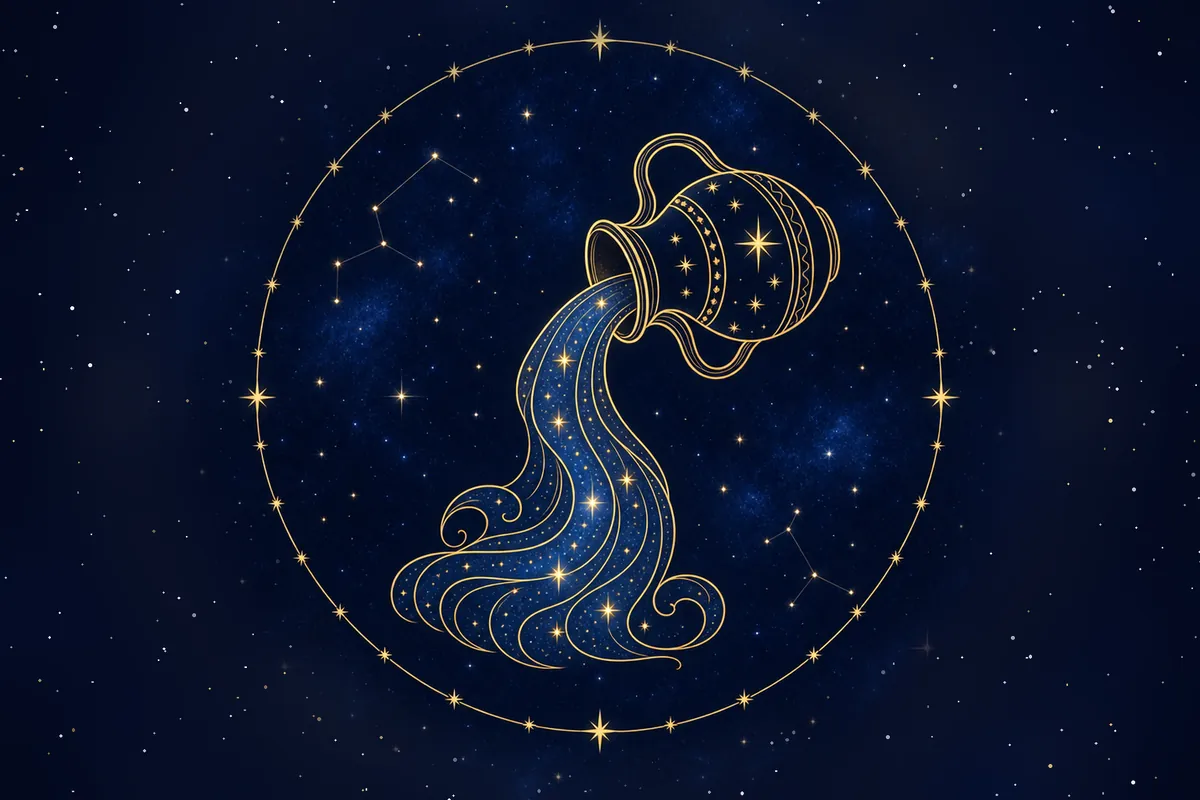
The Water Carrier symbol pictures a figure pouring water. It is often read as the gods nourishing the earth with life-giving energy. Encyclopaedia Britannica notes that the image may go back to ancient times, when the rising of the constellation Aquarius came during a season of rain and floods in the Middle East.
An earlier version of this page said Zeus was one of the first figures called the water bearer. The usual Greek myth is different. Ganymede, a Trojan prince, was carried up to Mount Olympus to serve as cupbearer to the gods, and he was later identified with the constellation Aquarius. The Greeks also linked the constellation with Deucalion, the survivor of a great flood.
Astrological signs and constellations no longer line up. Because of precession, the Sun now passes in front of the constellation Aquarius from about February 16 to about March 11, using the constellation boundaries the International Astronomical Union set in the 1930s. Western astrology still uses the sign dates of about January 20 to February 18.
The color most often linked with Aquarius is turquoise.

Turquoise, the Aquarius starstone
Turquoise is traditionally given as the starstone for Aquarius. According to the Gemological Institute of America (GIA), the name comes from an old French phrase meaning “Turkish stone,” because the gem probably first reached Europe through Turkish traders. The finest stones actually came from mines in Persia, now Iran. Marco Polo described turquoise in the mountains of eastern Persia. People have prized it for thousands of years.
Turquoise can be a pure, even color, or it can contain veins of other minerals, called matrix. When the matrix forms a web of linked shapes, the stone is called “spider-web” turquoise.
RE: STARSTONE CONTROVERSY
Starstones are not birthstones, and they have been confused with each other for centuries. A starstone, sometimes called a planet stone, is the stone astrologers link most strongly with a sign or its ruling planet. A birthstone goes with your birth month. Aquarius covers parts of January and February, whose standard birthstones are garnet and amethyst. If you want to compare lists, long-established astrology references such as Parker’s Astrology by Julia and Derek Parker are a good place to start.
Famous Aquarians who share your sign
- Charles August Lindbergh, lawyer, born January 20, 1859
- David Lynch, writer, born January 20, 1946
- Federico Fellini, screenwriter, born January 20, 1920
- Patricia Neal, actress, born January 20, 1926
- Christian Dior, businessperson, born January 21, 1905
- Jack Nicklaus, golf course designer, born January 21, 1940
- Plácido Domingo, actor, born January 21, 1941
- Mac Davis, actor, born January 21, 1942
- Jill Eikenberry, actress, born January 21, 1947
- Lord Byron, writer, born January 22, 1788
- Linda Blair, actress, born January 22, 1959
- Stendhal, writer, born January 23, 1783
- Édouard Manet, illustrator, born January 23, 1832
- Rutger Hauer, actor, born January 23, 1944
- Oral Roberts, healer, born January 24, 1918
- Robert Burns, writer, born January 25, 1759
- William Somerset Maugham, writer, born January 25, 1874
- Virginia Woolf, writer, born January 25, 1882
- Douglas MacArthur, military, born January 26, 1880
- Paul Newman, actor, born January 26, 1925
- Angela Davis, writer, born January 26, 1944
- Wayne Gretzky, restaurateur, born January 26, 1961
- Lewis Carroll, photographer, born January 27, 1832
- Colette, actor, born January 28, 1873
- Alan Alda, actor, born January 28, 1936
- Barbi Benton, actor, born January 28, 1950
- Anton Chekhov, writer, born January 29, 1860
- Germaine Greer, actor, born January 29, 1939
- Tom Selleck, actor, born January 29, 1945
- Oprah Winfrey, actor, born January 29, 1954
- Franklin Delano Roosevelt, statesperson, born January 30, 1882
- Dick Martin, actor, born January 30, 1922
- Vanessa Redgrave, actress, born January 30, 1937
- Franz Schubert, composer, born January 31, 1797
- Eddie Cantor, screenwriter, born January 31, 1892
- Jackie Robinson, vice president, born January 31, 1919
- Carol Channing, actress, born January 31, 1921
- Mario Lanza, actor, born January 31, 1921
- Norman Mailer, writer, born January 31, 1923
- Francis Bacon, writer, born February 1, 1561
- Clark Gable, actor, born February 1, 1901
- James Joyce, writer, born February 2, 1882
- Farrah Fawcett, actress, born February 2, 1947
- Gertrude Stein, writer, born February 3, 1874
- Fernand Léger, screenwriter, born February 4, 1881
- Betty Friedan, writer, born February 4, 1921
- Dan Quayle, businessperson, born February 4, 1947
- Alice Cooper, composer, born February 4, 1948
- Adlai Stevenson II, lawyer, born February 5, 1900
- Babe Ruth, baseball player, born February 6, 1895
- Ronald Reagan, screenwriter, born February 6, 1911
- Eva Braun, photographer, born February 6, 1912
- Rip Torn, actor, born February 6, 1931
- Fabian, screenwriter, born February 6, 1943
- Tom Brokaw, writer, born February 6, 1940
- Sinclair Lewis, writer, born February 7, 1885
- Alfred Adler, psychiatrist, born February 7, 1870
- Charles Dickens, writer, born February 7, 1812
- Garth Brooks, actor, born February 7, 1962
- Emmanuel Swedenborg, writer, born February 8, 1688
- John Ruskin, writer, born February 8, 1819
- Lana Turner, actress, born February 8, 1921
- James Dean, actor, born February 8, 1931
- Jack Lemmon, actor, born February 8, 1925
- Ronald Colman, actor, born February 9, 1891
- Carole King, actor, born February 9, 1942
- Joe Pesci, actor, born February 9, 1943
- Mia Farrow, actress, born February 9, 1945
- Boris Pasternak, writer, born February 10, 1890
- Harold Macmillan, politician, born February 10, 1894
- Mark Spitz, swimmer, born February 10, 1950
- Leontyne Price, singer, born February 10, 1927
- Burt Reynolds, actor, born February 11, 1936
- Abraham Lincoln, writer, born February 12, 1809
- John Llewellyn Lewis, politician, born February 12, 1880
- Lorne Greene, actor, born February 12, 1915
- Chynna Phillips, actor, born February 12, 1968
- Bess Truman, politician, born February 13, 1885
- Kim Novak, actress, born February 13, 1933
- Stockard Channing, actress, born February 13, 1944
- John Barrymore, actor, born February 14, 1882
- Jack Benny, actor, born February 14, 1894
- Jimmy Hoffa, writer, born February 14, 1913
- Hugh Downs, actor, born February 14, 1921
- Carl Bernstein, writer, born February 14, 1944
- Sara Jane Moore, accountant, born February 15, 1930
- Roger Bruce Chaffee, astronaut, born February 15, 1935
- Jane Seymour, actor, born February 15, 1951
- Anne of Great Britain, monarch, born February 16, 1665
- Edgar Bergen, screenwriter, born February 16, 1903
- Sonny Bono, screenwriter, born February 16, 1935
- Hal Holbrook, screenwriter, born February 17, 1925
- Ramakrishna, philosopher, born February 18, 1836
- Charles M. Schwab, businessperson, born February 18, 1862
- Adolphe Menjou, actor, born February 18, 1890
- Helen Gurley Brown, writer, born February 18, 1922
- Yoko Ono, photographer, born February 18, 1933
- John Travolta, actor, born February 18, 1954
- Merle Oberon, actress, born February 19, 1911
- Andrew Mountbatten-Windsor, duke, born February 19, 1960
- Justine Bateman, actress, born February 19, 1966
FAQ
What are the exact dates for Aquarius?
Aquarius usually runs from about January 20 to about February 18. In some years the Sun enters or leaves the sign a day earlier or later, so people born on the edge, called “on the cusp,” should check the exact time the Sun changed signs in their birth year. Some older books give January 21 to February 19.
Is Aquarius a water sign?
No. Despite the Water Carrier symbol, Aquarius is an air sign, along with Gemini and Libra. The water in the symbol stands for sharing knowledge and life-giving energy, not for the emotional water element of Cancer, Scorpio and Pisces.
Which planet rules Aquarius?
Modern astrology gives Aquarius to Uranus, the planet linked with change, invention and independence. Before Uranus was discovered in 1781, Saturn ruled the sign, and many astrologers still treat Saturn as its traditional ruler. Some readings use both.
Why is the Sun in the constellation Aquarius on different dates than the sign?
Earth’s axis slowly wobbles, which is called precession. Over about two thousand years, that wobble has moved the constellations out of line with the zodiac signs. The Sun now crosses the constellation Aquarius from about February 16 to March 11, but Western astrology keeps the older sign dates.
Which signs are most compatible with Aquarius?
Astrology traditionally pairs Aquarius best with the other air signs, Gemini and Libra, and with the fire signs Aries and Sagittarius. Taurus and Scorpio are often called the most challenging matches. Compatibility charts are a fun conversation starter, but they can’t predict how any real relationship will go.
What is the difference between the Aquarius starstone and birthstone?
The starstone, turquoise, is linked with the sign and its ruling planet in astrological tradition. Birthstones follow the calendar month, so an Aquarian born in January has garnet and one born in February has amethyst. Neither choice is more “correct.” They come from different traditions.
Sources
- NASA Space Science Data Coordinated Archive: Uranus Fact Sheet
- NASA Science: New moon discovered orbiting Uranus using NASA’s Webb telescope
- NASA Science: Hubble helps determine Uranus’ rotation rate with unprecedented precision
- Encyclopaedia Britannica: Aquarius
- Encyclopaedia Britannica: Ganymede (Greek mythology)
- EarthSky: Dates of the Sun’s entry into each constellation of the zodiac
- GIA: Turquoise history and lore
- Quaker Faith & Practice, Chapter 1: Advices and Queries
- Julia and Derek Parker, Parker’s Astrology (Dorling Kindersley)