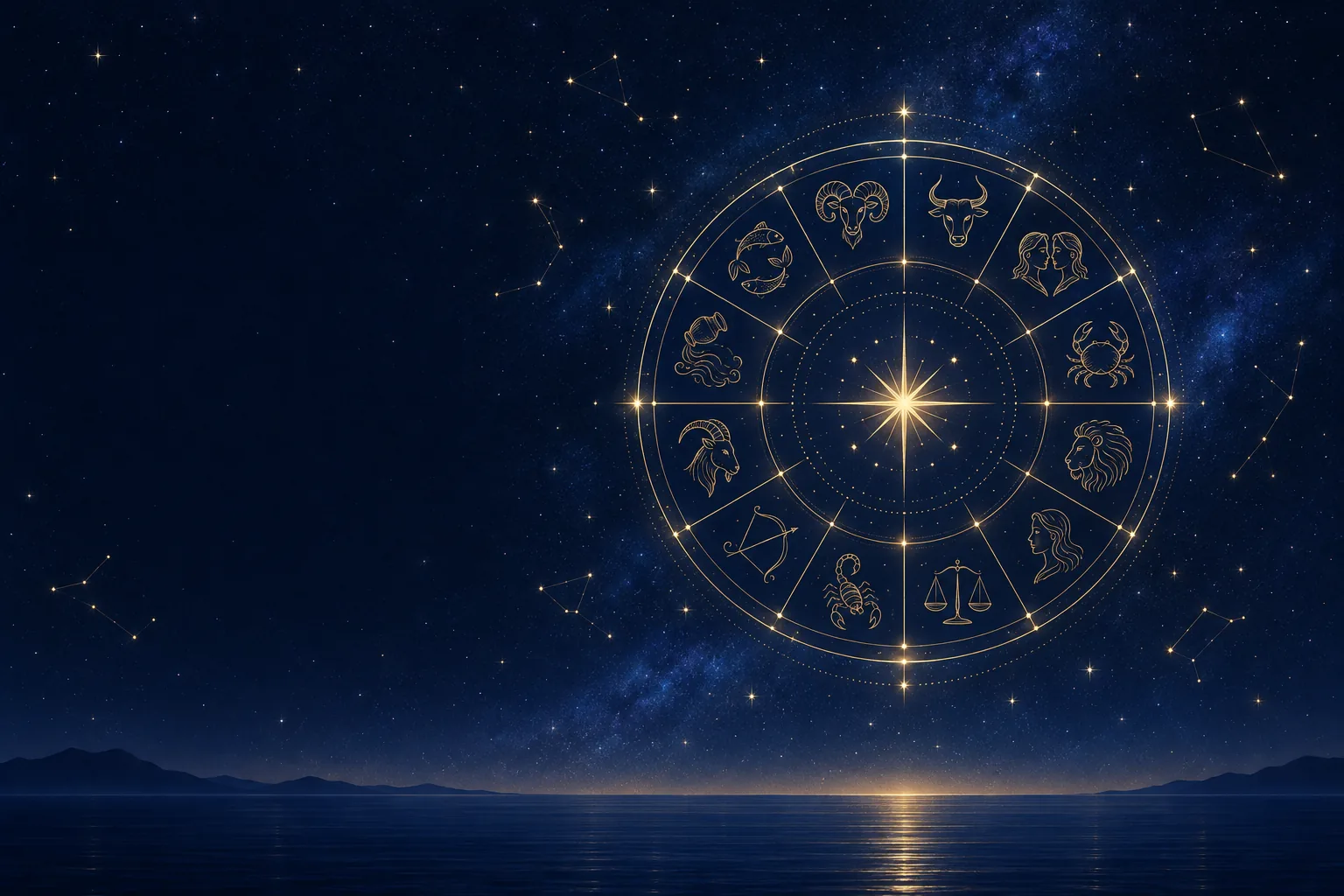
Western astrology is a tradition, more than 2,000 years old, that reads meaning into where the Sun, Moon and planets were at a given moment. Its best-known tool is the zodiac: 12 Sun signs, from Aries (about March 21 to April 19) to Pisces (about February 19 to March 20), each linked to a set of traits. The start and end dates of every sign can move by a day in some years, because the Sun does not change sign at the same moment every year. People use astrology today for reflection and fun. It is not a science, and it can’t tell you for certain what will happen.
Basic astrology
The first thing to drop is the idea that astrology is a secret art that only mystics can follow. Some modern astrology is presented that way. Traditional Western astrology is closer to a system of rules and tables than to anything occult.
Astrology also has a long shared history with astronomy. Babylonian scholars were recording omens from the sky by about 1800 BC. In the second century AD, the Alexandrian astronomer Ptolemy wrote both the Almagest, a work of astronomy, and the Tetrabiblos, which became a foundation text of Western astrology. For centuries the two subjects were studied together and used the same planetary tables that astronomers and navigators relied on. They separated during the scientific revolution of the 17th century. Today astronomy is a science and astrology is not. Controlled studies have not shown that astrology can predict personality or events.
Don’t expect any horoscope, from any source, to tell you a fixed future. Astrology works best as a language for talking about tendencies, personality and possibilities. Astrologers describe character traits, point to challenges and opportunities that might come up, and suggest ways to respond. Nothing in a chart overrides your own choices, and no reading should replace advice from a doctor, lawyer or financial professional.
How horoscopes for each sign work
A Sun-sign horoscope is a short, general forecast written for everyone born under one sign. It is a moving target: horoscopes change day to day as the Moon and planets move, so a daily, weekly or monthly reading only covers that period.
Most horoscopes for a sign build on the same foundations:
- The sign’s traits: the personality qualities tradition gives the sign, such as boldness for Aries or caution for Capricorn.
- Element and mode: fire, earth, air or water, and cardinal, fixed or mutable (explained below).
- Ruling planet: the planet linked to the sign, whose movements astrologers watch most closely for that sign.
- Areas of life: work, relationships, money, home and health habits, which astrologers connect to the “houses” of a chart.
The dates of the astrological signs (the zodiac)
The zodiac is a belt of sky stretching about 9 degrees on either side of the ecliptic, the Sun’s yearly path against the stars. Western astrology divides it into 12 equal signs of 30 degrees each. The count starts at the spring (March) equinox, which marks the start of Aries.
A note on calendar history: January 1 has not always been New Year’s Day in England. In the Anglo-Saxon period the year often began at Christmas, December 25. From the Middle Ages, England’s legal year began on March 25, Lady Day. The Calendar (New Style) Act 1750 moved New Year’s Day to January 1, starting in 1752. That same year, Britain and its colonies dropped 11 days, so Wednesday, September 2, 1752 was followed by Thursday, September 14. Scotland had already switched to a January 1 New Year in 1600.
The zodiac’s starting point is much older than those English calendar rules. Since Ptolemy’s time, the astrological year has begun at the spring equinox, so Aries comes first and the other signs follow in order. The equinox usually falls on March 20 in UTC, and sometimes on March 19 or 21. In 2026 the March equinox came on March 20 at 14:46 UTC. Each sign has its own characteristics.
Signs versus constellations
Signs and constellations are not the same thing. The signs are fixed to the seasons. The constellations are star patterns: the International Astronomical Union (IAU) adopted a list of 88 in 1922 and set their official boundaries in 1928, and the boundary descriptions were published in 1930. Those boundaries are unequal. The Sun spends about a week in front of Scorpius and more than six weeks in front of Virgo. It also passes through a 13th constellation, Ophiuchus, which astrology does not use as a sign.
The two calendars have drifted apart because of precession, a slow wobble in Earth’s axis. Around 2,000 years ago, the signs and their namesake constellations roughly lined up. Now the Sun sits in front of the constellation before the one that gives its sign its name for most of each sign’s dates. On January 1, for example, the Sun appears in Sagittarius, not Capricornus.
The table below gives the usual sign dates and the approximate dates when the Sun appears in front of each constellation. Neither the signs nor the constellations change over at exactly midnight on these dates, so expect a difference of up to a day at the start or end of each period.
| Name of sign | Usual dates of the sign | Sun in front of the constellation (approx.) |
|---|---|---|
| Aries | March 21 to April 19 | April 18 to May 13 |
| Taurus | April 20 to May 20 | May 13 to June 21 |
| Gemini | May 21 to June 20 | June 21 to July 20 |
| Cancer | June 21 to July 22 | July 20 to August 10 |
| Leo | July 23 to August 22 | August 10 to September 16 |
| Virgo | August 23 to September 22 | September 16 to October 30 |
| Libra | September 23 to October 22 | October 30 to November 23 |
| Scorpio | October 23 to November 21 | November 23 to November 29 (Scorpius) |
| (no sign) | None | November 29 to December 17 (Ophiuchus) |
| Sagittarius | November 22 to December 21 | December 17 to January 20 |
| Capricorn | December 22 to January 19 | January 20 to February 16 (Capricornus) |
| Aquarius | January 20 to February 18 | February 16 to March 11 |
| Pisces | February 19 to March 20 | March 11 to April 18 |
An older version of this table gave quite different constellation dates. The column above follows the IAU boundaries, which astronomy sites such as EarthSky use.
If you were born well inside one of these periods, you can safely call yourself a Gemini, a Leo and so on. If you were born near a borderline date (often called a “cusp”), you need your exact birth time and place to work out your Sun sign. At any given moment the Sun is in one sign or the other, never both. Your birth time and place also set your rising sign and the houses of your chart.
Characteristics of the signs
Besides its own traits, each sign is grouped in three other ways:
- Polarity. Each sign is either positive, traditionally called “masculine” (outgoing, spontaneous and self-expressive), or negative, traditionally called “feminine” (inward-looking, receptive and reflective). Many modern astrologers say “active” and “receptive” instead.
- Element (the triplicities). Each sign belongs to one of four elements: fire (lively and assertive), air (quick-minded and good with words), earth (practical and controlled) or water (sensitive and intuitive). If there are four elements, why is the group called a “triplicity”? Because each element contains three signs.
- Mode (the quadruplicities). Each sign is cardinal, fixed or mutable. The name comes from the fact that each mode contains four signs. Cardinal stands for initiative, fixed for steadiness and mutable for change and adaptability.
Notice how logical the names are: a “fixed” sign is steady, and a “mutable” sign is changeable. Many terms in astrology work like this.
Tip: look for these logical connections. They make the system easier to memorize and easier to understand.
Table of sign characteristics
| Sign | Quality | Triplicity | Quadruplicity | Traditional ruler | Modern ruler |
|---|---|---|---|---|---|
| Aries | Positive | Fire | Cardinal | Mars | Mars |
| Taurus | Negative | Earth | Fixed | Venus | Venus |
| Gemini | Positive | Air | Mutable | Mercury | Mercury |
| Cancer | Negative | Water | Cardinal | Moon | Moon |
| Leo | Positive | Fire | Fixed | Sun | Sun |
| Virgo | Negative | Earth | Mutable | Mercury | Mercury |
| Libra | Positive | Air | Cardinal | Venus | Venus |
| Scorpio | Negative | Water | Fixed | Mars | Pluto |
| Sagittarius | Positive | Fire | Mutable | Jupiter | Jupiter |
| Capricorn | Negative | Earth | Cardinal | Saturn | Saturn |
| Aquarius | Positive | Air | Fixed | Saturn | Uranus |
| Pisces | Negative | Water | Mutable | Jupiter | Neptune |
Ancient astrologers only knew of seven bodies, from the Sun and Moon out to Saturn, and gave each sign one of them. After Uranus, Neptune and Pluto were discovered, modern astrologers gave them Aquarius, Pisces and Scorpio. Traditional astrologers still use only the older rulers. Many modern astrologers use both, treating Mars, Saturn and Jupiter as co-rulers of those three signs.
Where to go from here
Your Sun sign is only the starting point. A full birth chart also places the Moon, the planets, the rising sign and the 12 houses, so two people with the same Sun sign can read very differently. The most useful next step is to learn your sign’s element, mode and ruler from the tables above. Then read any horoscope as a prompt for reflection, not as a forecast of fact.
FAQ
Why do different sources give slightly different dates for the same sign?
Signs change when the Sun reaches a set point on the ecliptic, and the exact moment shifts a little each year because of how the calendar and leap years line up. Time zones matter too: a change that happens late on one day in UTC can fall on the next day in Asia or Australia. That is why a sign’s first or last day can move by a day.
Is Ophiuchus a 13th zodiac sign?
No, not in Western astrology. The Sun does pass in front of the constellation Ophiuchus from about November 29 to December 17. But astrology’s 12 signs are equal 30-degree sections tied to the seasons, not the star patterns. NASA has said plainly that it did not change the zodiac. It only explained that Babylonian astronomers divided the ecliptic into 12 equal 30-degree signs, named for constellations along it.
What does it mean to be born “on the cusp”?
You were born on or near the day the Sun moved from one sign to the next. Astrologically, the Sun was in exactly one sign at your moment of birth. Your birth time and place show which one, and free chart calculators work this out from those details.
Is astrology a science?
No. In the ancient world it was studied together with astronomy, but the two separated centuries ago. Studies have not found that astrology predicts personality or events. Many people still enjoy it as a cultural tradition and a tool for reflection.
What is the difference between tropical and sidereal astrology?
Tropical astrology, the system used in most Western horoscopes and on this page, starts Aries at the March equinox, so the signs follow the seasons. Sidereal astrology, used in Indian (Vedic) astrology, adjusts the signs for precession so they stay closer to the actual constellations. Under sidereal reckoning, many people’s Sun sign shifts back by one.
Do daily horoscopes stay the same from year to year?
No. Horoscopes change day to day because the Moon and planets keep moving. A forecast only applies to the day, week or month it was written for. The parts that stay constant are the sign’s traits, element, mode and ruling planet.
Sources
- EarthSky: Dates of the Sun’s entry into each constellation of the zodiac
- EarthSky: Sun in Ophiuchus
- Go-Astronomy: Zodiac constellations
- Time: No, NASA didn’t change the zodiac
- Encyclopaedia Britannica: Zodiac
- Encyclopaedia Britannica: Astrology in the Hellenistic period
- National Geographic: What are the ancient origins of your zodiac sign?
- legislation.gov.uk: Calendar (New Style) Act 1750
- History Today: The Gregorian Calendar Adopted in England
- Live Science: Vernal equinox 2026
- The Astrology Podcast: The Signs of the Zodiac, Qualities and Meaning