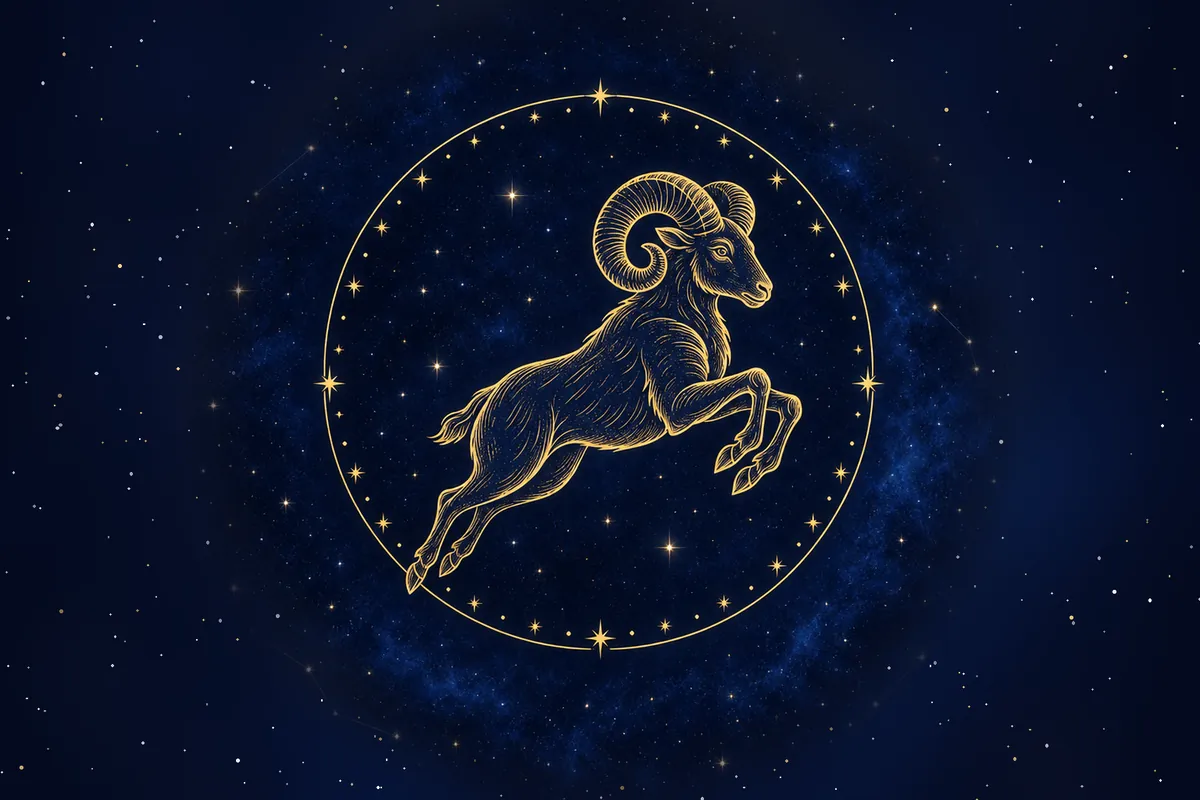
Aries is the first sign of the Western zodiac. It covers people born from about March 21 to April 19, though the start and end dates can move by a day in some years because the Sun’s entry into each sign shifts slightly. In 2026, for example, the Sun entered Aries on March 20 and left it on April 19. The sign is linked with fire, the planet Mars and the symbol of the ram, and astrologers describe it as bold, direct and quick to start things. People read it as a tradition for reflection and fun. It is not a science.
The Aries personality
Aries people are usually described as lively and full of energy. In astrology, the typical Aries is a pioneer in thought and action, very open to new ideas and fond of freedom. Aries people welcome challenges and rarely let anything turn them from their purpose. The main exception is their own impatience, which shows when results come slowly.
Aries people are courageous leaders
Astrologers see Aries people as responsible leaders who care about the people they lead. They seldom use others to reach their own goals, but it can happen. They make poor followers because they like to take charge, and they may refuse to follow directions they disagree with or can see no reason for.
Self-focus works both ways for this sign. Aries people are self-reliant, but they can also be self-centred and preoccupied with their own progress and physical comfort. All that energy can make them pushy and restless. At times they can be argumentative, headstrong, quick-tempered and easily offended, and they may hold a grudge after a perceived insult.
As the first sign of the zodiac, the Aries role is simply to start something and lead the way. Astrologers say the Sun in this position gives your will free rein. You might show it through leadership, or by getting others to see themselves in a new way, or by acting on purpose for a cause that moves you. The downside is that people can find it hard to get to know the real you.
In personal relationships, Aries people are frank
You tend to be direct and candid, and you make an enthusiastic, generous friend. Traditional texts describe Aries as passionate in love but also particular. There is a less flattering side too. Slow or cautious companions can irritate you, and although you are sensitive yourself, you can trample on other people’s feelings.
Older astrology books warned that this intensity could lead Aries people to chase new romances, or to rush into commitment too young. Treat that as a traditional caution, not a forecast. Those same books describe Aries parents as fiercely protective and devoted to their children.
Astrologers suggest that you recognise your pioneering spirit instead of ignoring it. Owning it helps you enjoy life more and makes it harder for others to push you around. The Aries pattern is often described as “push or be pushed”, with little middle ground. Other people may find that hard at times, but you need room to act rather than just think, or the frustration builds up. Resentment, regret and self-pity are said to be especially bad for this sign, because they work against its natural directness.
Mentally, Aries people are quick and objective
Aries people are described as sharp and objective. In rare cases they can become rigid or extreme in their religious or political views. They are natural champions of lost causes and last stands. They think fast but can be reckless and too optimistic, and they often rush into projects without checking the details or the difficulties. Traditional astrology says the biggest task for Aries is self-control: steering their drive so it helps the people around them instead of harming them.
As an Aries, you like a challenge that stirs you into action. Sometimes it starts as plain frustration. At its best, you know exactly what or whom you are fighting for. If your direction is unclear, astrologers suggest you stop and ask yourself what you really want. An Aries without a direction or a cause is said to be going against its own nature, more sheep than ram.
Aries and the courage to be forceful
Astrologers see forcefulness as the core of the Aries nature. Some writers suggest that an Aries who feels held back by fear may want to think about past experiences, such as a childhood home that discouraged independence. The same writers say hard experiences can also push the other way and make someone overly forceful or careless about their own needs. Astrology is a prompt for reflection here, not a diagnosis. If old experiences still weigh on you, a qualified counsellor is the right person to talk to.
Careers traditionally linked with Aries
Traditional texts list these Aries careers:
- Athletes and climbers
- Doctors
- Explorers of new ideas and new places, including space
- Soldiers, sailors and pilots
- Leaders in business and politics (but awkward employees)
The ram and the lamb
You may be the Ram, but there is still a little lamb in you. Sometimes you will reach your goals more easily by giving way gently to what a situation demands than by locking horns with something bigger than you. It is a bit like knowing the difference between what you can change and what you cannot. That takes patience, which astrologers call the greatest thing an Aries can learn, along with accepting their own softer side.
Traditional health associations
In traditional astrology, Aries rules the head and brain. Old texts link the sign with headaches, sunstroke and nervous tension, and they say its rashness makes accidents and injuries more likely. These are symbolic links from a centuries-old tradition, not medical facts. Your star sign tells you nothing about your health, so see a doctor about any symptoms.
The same texts say Aries people like extremes, whether physical, emotional or mental, and often gain from them. They add that pushing too far beyond what others accept can leave you isolated.
Likes and dislikes
Likes
- Action
- Coming first
- Challenges
- Championing causes
- Spontaneity
Dislikes
- Waiting around
- Admitting failure
- Having no opposition
- Tyranny
- Other people’s advice
Common problems and suggested solutions
Every Sun sign has its own traits. Astrologers say problems tend to appear when those traits are held back or not used well. The pairs below give the traditional Aries reading. Treat them as prompts for reflection, not guaranteed fixes. If you keep running into the negatives, the tradition says it is usually because the positive side of the sign is not getting expressed.
| Problem | Suggested solution |
|---|---|
| Projects that come to nothing, and partnerships full of conflict | See yourself as the “ideas person” and inspire others to carry the ideas out. Practise listening more than speaking. |
| No real focus or direction, and only pretending to be decisive | Your actions reflect what is going on inside you. Take time to work through issues you may have buried. |
| People drifting away because nothing else gets you to notice their feelings | Look honestly at your attitude and put yourself in their shoes. |
| Tripping yourself up, inviting conflict, then feeling deflated | Look before you leap. Work out what you want to happen first, then act. |
Ruling planet: Mars
Mars, the planet named after the Roman god of war, is the traditional ruler of Aries. 
Here is how NASA’s planetary fact sheet describes the real planet:
| Mars fact | Value |
|---|---|
| Mean distance from the Sun | 1.524 AU |
| Time to orbit the Sun (sidereal period) | 1.88 Earth years (about 687 days) |
| Equatorial radius | 3,396 km |
| Polar radius | 3,376 km |
| Rotation period | 24.62 hours |
| Tilt of equator to orbit | 25.19 degrees |
| Known moons | 2 (Phobos and Deimos) |
Mean Radius Distance from Planet Satellites: (km) (x 1,000 km) Phobos 11 9.38 Deimos 6 23.48
More facts about Aries

The sign’s animal is the ram, and its glyph (♈) is a stylised pair of horns. Older guides said the ram symbol first appeared in Egypt, sometimes swapped with a goose’s head, and that its origin was a mystery. Historians usually trace the constellation back to Babylonian star lists. In Greek myth, it is the ram whose golden fleece Jason and the Argonauts went looking for.
The colour traditionally linked with Aries is red, the colour of Mars and of fire.
RED
Starstone: diamond

The Aries starstone is the diamond. Diamonds have been prized for centuries for their beauty and hardness, and gem folklore gives them many powers. In that folklore, a diamond adds charm and beauty to the wearer, and old texts claim it protects the body in serious illness. That is legend, not medicine. The ancient Romans reportedly believed a diamond worn on the left arm, against the skin, brought courage. Gem lore also tells of Queen Elizabeth I being given a diamond to ward off the plague. Older versions of the story place it in the Middle Ages, but Elizabeth reigned from 1558 to 1603, after the medieval period, and the tale is folklore rather than recorded history.
RE: STARSTONE CONTROVERSY
People have long argued about “starstones”. A starstone is not the same as a birthstone. A starstone (or planet stone) is the gem said to suit your sign or ruling planet, while a birthstone goes with the calendar month you were born in. For Aries the two partly overlap, because the diamond is also the modern birthstone for April. Long-running reference books such as Parkers’ Astrology by Julia and Derek Parker, published by Dorling Kindersley, are a good place to compare the traditional lists.
Aries the sign vs Aries the constellation
The sign and the star pattern no longer line up. Western astrology uses the tropical zodiac, which starts Aries at the March equinox every year. Over about 26,000 years, Earth’s axis slowly wobbles (this is called precession). Because of that wobble, the Sun now crosses the actual constellation of Aries from around April 18 or 19 to about May 13 or 14. NASA has also pointed out that the Sun passes through 13 constellations, including Ophiuchus. This does not change anyone’s astrological sign, because the signs are fixed to the seasons, not to the stars behind them.
What an Aries horoscope usually focuses on
Horoscopes change from day to day and week to week, and they are meant as prompts, not predictions. An Aries reading usually comes back to the same themes:
- Energy and initiative: new starts, fresh projects and how hard to push.
- Mars: what the ruling planet is doing, especially when it changes sign or appears to move backwards (retrograde).
- Patience and temper: where hurrying or anger could backfire.
- Leadership and independence: work moves, competition and standing up for yourself.
- Relationships: honesty and passion, and making room for slower partners.
- Aries season: the yearly stretch from late March to mid April, which many astrologers treat as the start of the astrological year.
FAQ
What are the exact dates for Aries?
Aries usually runs from March 21 to April 19. The Sun enters the sign at the March equinox, which can fall on March 20, and it can leave on April 19 or April 20, depending on the year and your time zone. If you were born on one of those edge days, check the Sun’s position for your birth year.
What element and planet go with Aries?
Aries is a fire sign and a cardinal sign, meaning it starts a season. Its traditional ruling planet is Mars. Its opposite sign is Libra, which is ruled by Venus.
Which signs are most compatible with Aries?
Traditional astrology pairs Aries with the other fire signs, Leo and Sagittarius, and with all three air signs: Gemini, Libra and Aquarius. Libra, its opposite, is seen as a pairing of strong attraction and real differences. These are fun guidelines, not rules. No real relationship depends on star signs.
Is the diamond the Aries birthstone or starstone?
It can be both. In astrological tradition the diamond is the Aries starstone, and on the modern list it is also the birthstone for April. Aries people born in March would have aquamarine as their birth-month stone instead.
Did NASA change the Aries dates?
No. NASA has explained that the Sun passes through 13 constellations and that the star patterns have shifted against the calendar. It also made clear that it did not change the zodiac. The astrological dates for Aries are still March 21 to April 19.
Is astrology scientific?
No. Astronomy, the science of stars and planets, and astrology, the tradition of reading meaning into them, split apart centuries ago. Encyclopaedia Britannica traces horoscope astrology to Babylonian diviners and its later development in the Hellenistic world. Many people today use it for self-reflection and entertainment.
Sources
- NASA Space Science Data Coordinated Archive: Mars Fact Sheet
- NASA: Mars Lithograph
- NASA Space Place: Star Finder (archived)
- Encyclopaedia Britannica: Aries
- Encyclopaedia Britannica: Astrology in the Hellenistic period
- EarthSky: Dates of the Sun’s entry into each sign of the zodiac
- EarthSky: Sun in zodiac constellations
- TIME: NASA and the zodiac
- DK: Parkers’ Astrology by Julia and Derek Parker
- Cafe Astrology: Sun enters Taurus 2026